
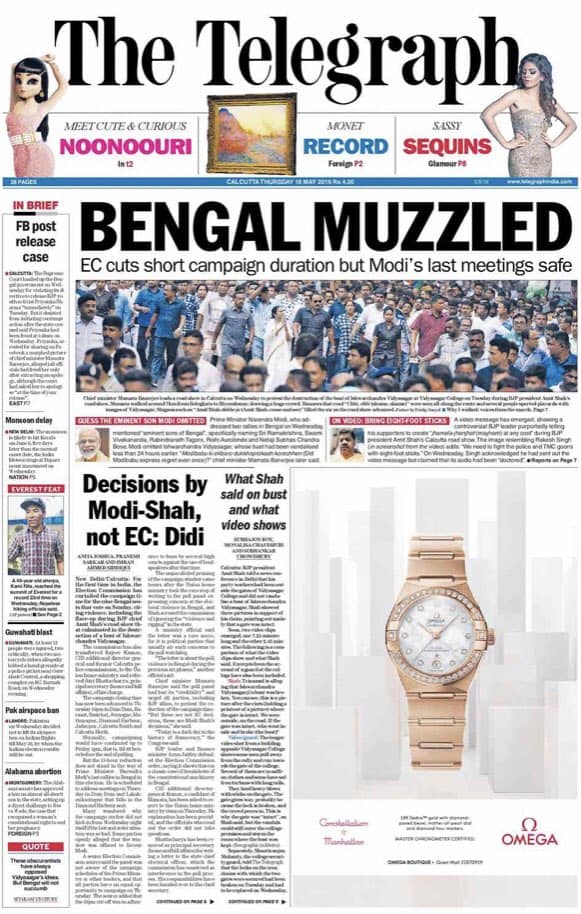
On May 16, The Telegraph‘s front page headline read “Bengal muzzled — EC cuts short campaign duration but Modi’s last meetings safe”. The Election Commission on Wednesday had invoked Article 324 to curtail the campaigning in nine West Bengal constituencies a day before its scheduled deadline. The development came in the wake of violence between BJP and Trinamool Congress workers in Kolkata.
West Bengal’s polls and campaigning this Lok Sabha election has seen massive amounts of violence. The latest in the line of events is the destruction of a statue of Ishwarchandra Vidyasagar, a nineteenth-century Bengali educator and social reformer. Streets of North Kolkata turned into a battlefield as clashes took place during a roadshow led by Bharatiya Janata Party (BJP) president Amit Shah. As per news reports, Shah’s roadshow turned violent after TMC workers protested the roadshow with placards of “Amit Shah Go Back”. Subsequently, BJP workers entered the Vidyasagar College in North Kolkata and ransacked the premises, and vandalised a bust od Vidyasagar situated inside the college premises.
While the national media and TV channels continued to report on the violence, amidst claims made by Shah and Narendra Modi that the TMC was responsible for this, in an unsigned editorial on the same day, The Telegraph‘s editors wrote, “Darkness abhors light. History is thus replete with examples of authoritarian forces directing their venom towards figures associated with enlightenment. In a contemporary expression of this animosity, a statue of Ishwarchandra Vidyasagar, a luminary who challenged orthodoxy in the sphere of thought, faith and learning, was vandalised by supporters of the Bharatiya Janata Party during a roadshow led by its president in the heart of Calcutta.”
It further reads, “There is a method in this madness. Extremist ideologies — be it the ultra-Right or the leftist variety — are particularly allergic to the idea of reform. Little wonder then that the BJP now finds itself in the august company of Naxalites who had disfigured a statue of the Renaissance man earlier. At the heart of reform lies the promise of emancipation from conservatism, prejudice and discrimination, elements that are allegedly integral to Hindutva, the political ideology that the BJP and its patrons are eager to impose on pluralist India.”
With many channels resorting to air the views of the members of the ruling party, rather than investigate what the truth was, it was AltNews, the fact-checking website that produced a stellar investigative piece, piecing together information the debunk claims made by the saffron party. Pooja Chaudhari of AltNews debunked falsities spread by Amit Malviya, head of BJP IT Cell.
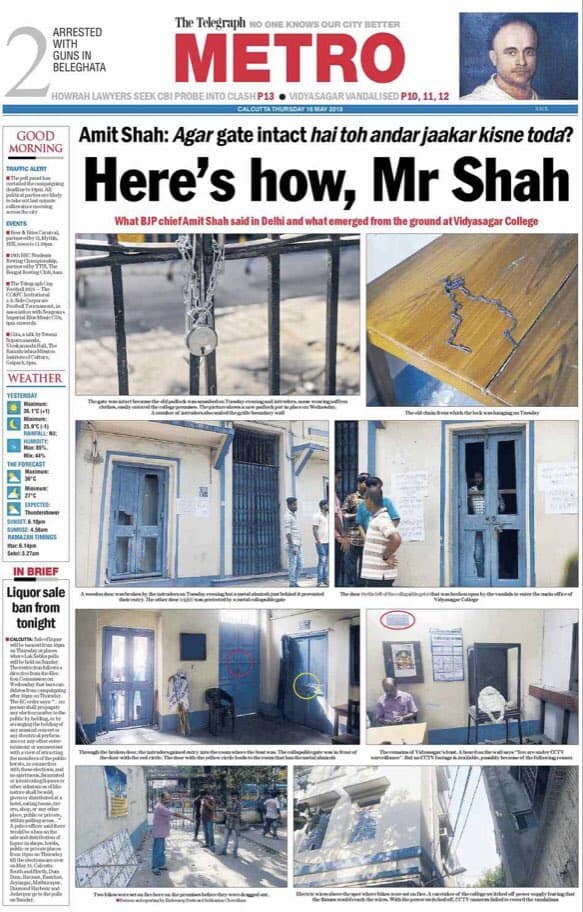
The Telegraph, too, was not behind in this matter. In a report titled, “Here’s How, Mr Shah”, the daily fact-checked Amit Shah’s claims — “Agar gate intact hai toh andar jaa kar kisne toda?” with a thorough ground report.
The Telegraph‘s journalism, in an age of pliant — and sometimes “non-political” — interviews, at a time when merely reporting what leaders are saying sans context, is one that has to be commended.