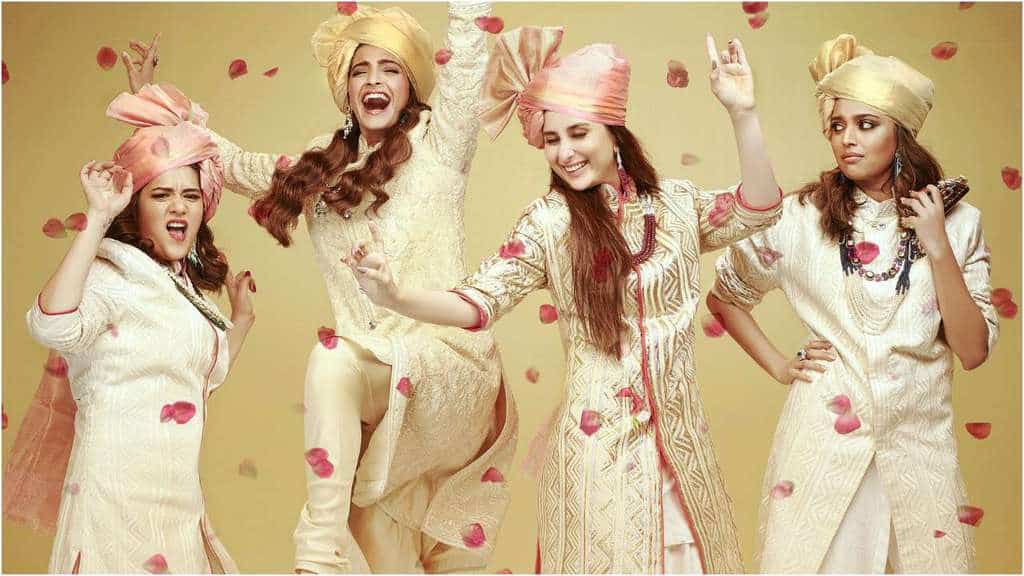
Amid the negative buzz of detraction against the film on the social media, when one walked inside the theatre for a night show on the opening day of Veere Di Wedding, one was surprised to find a rare, fully-packed house.
When one walked out of the theatre later that night after having watched what was quite clearly a mediocre work from all accounts of filmmaking, curiously, one was amused rather than annoyed.
But first things first. What is the film about and how has it been made?
The film is the story of 4 young girls, 4 friends, and the mistakes they make along with the fun they have in their teenage and youth while negotiating life.
Is it well made? Well, not so much. As an artistic depiction, the film leaves you wishing for a better product. It is entertaining sporadically, marred by a script and characterizations that weren’t evolved well enough. The screenplay suffers, as a result, and the film drags a bit. The direction is wanting of the ‘Dil Chahta Hai’ vision and finesse (since some viewers compare the two films). The characters are a bit over-the-top at many places, which, because they also are wanting in depth, makes them appear insincere at places. The dialogues tend to get a tad bit monotonous in their imagery: young girls of Delhi perhaps do speak that language while teasing each other, but is it that often? The performances, even in crucial scenes, make you feel like you would have gone for another take if you were directing them.
Why is the film important, then? Why even attempt to write about it?
The answer to this is in 3 things referred to earlier: the fully-packed house, the feeling the film left you with, and the negative buzz.
Why didn’t the mediocre film annoy me? Why are people going to watch it? Why are some people opposing it?
Breaking Stereotypes
The film doesn’t annoy because it does some active and desirable breaking of stereotypes.
Its underlying theme is ‘make your own mistakes and learn from them; don’t run away from life for fear of making mistakes’. And so, the film shows the young girls making mistakes left, right and center: wrong guy for teenage romance, wrong guy for early marriage, wrong guy to have had an affair with at the workplace, wrong guy to get physically intimate with at the friend’s wedding, running away from one’s own wedding, fear of commitment, etc.
In this scheme of things, Bollywood’s depiction of the ‘pure woman’ stereotype gets left out by the wayside.
The second stereotype debunked: Women aren’t sexual beings, more so before marriage. So, there’s a lawyer constantly pestered by her mom to get married and has to keep meeting ‘prospective grooms’ and when she does get attracted to one of them and wants to kiss him, the guy rejects her, literally getting a fit over the fact that he was looking for getting married and not for “hooking up”! On a rebound almost, she gets drunk and ends up sleeping with someone she barely knows or even likes. A big mistake, she admits, and regrets it, but doesn’t kill herself over the regret, nor does anyone else kill her for that! She remains the normal girl that she is.
There’s her friend who is getting married to someone she loves and has been living with for 3 years; the ‘about-to-be-married couple’ cozy up often. A third friend, the most unabashed of them all, marries young and isn’t compatible with the guy. One day, when the marriage is on the verge of breaking, she embarrasses her husband accidentally as he walks in on her when she is pleasuring herself. However, instead of responding to it like a life partner should perhaps have, the husband responds with blackmailing her to stay in the marriage lest he tells the entire world ‘what kind of woman she is’! The fourth friend is dealing with an inter-continental marriage and family opposition, along with post-partum body image issues affecting her intimacy with her husband. So, yes, this Bollywood heroine has not regained her original figure within seconds of childbirth!
It isn’t just the women, but the men in the film too break stereotypes: all the positive male characters. Sumeet Vyas, who plays Kareena’s boyfriend, is a remarkable depiction: he is very much your regular Delhi guy, but one not trapped in his patriarchal ego’s snares. It’s a character which wouldn’t be difficult for most men to identify with and even emulate. I would say he is the best-developed character in the film. The character depicting Sonam’s one-night escapade is shown as fully respectful of her consent, even as he pursues her and accepts her rejections. As a result, she isn’t shown afraid of him or hating him.
The opposition
After the film’s release, some people have expressed horror at its content. Especially the scene where one of the girls is shown masturbating, using a vibrator. On social media, similar messages (almost verbatim) have been posted against the film from multiple accounts! The objection is about the depiction going against our social norms and ‘sanskar’ and having hurt family sentiments.
Is there a pattern here? Denial of realities? Prescription of an alternate, more conservative but more desirable realities for some?
This is what the Indian woman needs to understand.
Coincidentally, it is from amongst people with a similar world view that other denials and prescriptions have emanated in the past. Denial of the exercise of various rights and personal liberties for women. Denial of other instances or allegations of harassment, some very serious ones. Prescriptions about what women should wear, how they should behave, even what they should eat, etc. What does this tell the Indian woman?
The Audience
The film opened to a 10.7 crore business on its first day. The people are somewhere either identifying with the film’s depiction or, if not so, at least they aren’t rejecting it; in fact, by the looks of it, they are even finding entertainment in it. That’s big in itself. It shows a certain coming of age of the Indian audience, a maturity if you will. Whatever their individual beliefs may be, the people are not threatened by the expressions in a film. In one word, ‘tolerance’.
Also, while at many places you do feel that the depiction in the film is somewhat exaggerated, like most commercial Bollywood products are, by and large, if people agree with even 65-70% of the portrayal of the 4 girls, it also shows that their world view is not congruent with that of many of those opposing it. This is important.
Veere Di Wedding, is, thus, a mediocre film if you analyze its craft, but an interesting one socially, given its messaging.
Rachna Sinha works in the academic books and journals publishing industry, and has a background in publishing, journalism and research.