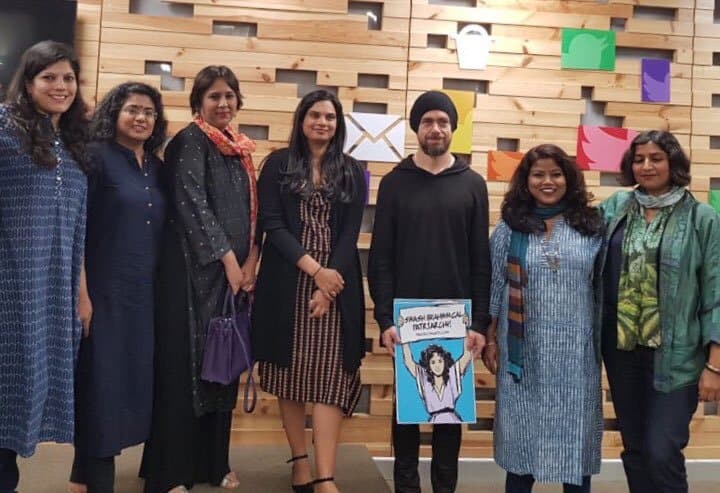
Twitter’s policy on abuse, bullying and hate crime may be more opaque than what one would wish for, but the social media website’s stance on caste issues — or the lack of it — is crystal clear. When Twitter CEO Jack Dorsey, during his latest visit to India, met a group of women journalists, activists and writers, he found himself in a photograph with the, clutching a poster that bore the legend: “smash Brahmanical patriarchy”.
During Twitter CEO @jack‘s visit here, he & Twitter’s Legal head @vijaya took part in a round table with some of us women journalists, activists, writers & @TwitterIndia‘s @amritat to discuss the Twitter experience in India. A very insightful, no-words-minced conversation ???? pic.twitter.com/LqtJQEABgV
— Anna MM Vetticad (@annavetticad) November 18, 2018
The image was, of course, met with outrage from the Indian Right and caste apologists who chose to misconstrue a call to annihilate the constructs of caste and patriarchy — and their inevitable intersection — as “hate crime”. Jack Dorsey may or may not have views on the pervasiveness of casteism in Indian society, but the Hindu-Right on Twitter equated the Twitter CEO holding a poster in one photo as a call for attack on Brahmins.
Sanghapali Aruna, the founder of Project Mukti, who gifted Dorsey with the poster told The Print, “Brahmanical patriarchy controls all of us in more ways than one. Brahmin women have been one of the victims of this hegemony. The ‘Smash Brahmanical patriarchy’ poster which I gifted to Jack Dorsey was questioning precisely this hegemony and concentration of power in the hands of one community. This wasn’t an attempt at hate speech against the Brahmins, but was an attempt to challenge the dominance and sense of superiority that finds its origins in the caste system.”
Yet, most outraging against it chose to don blinkers and cry foul.
TV Mohandas Pai, in his Republic editorial wrote: “The poster is an indication of the communal hatred of the people who made it and by holding it, the CEO of Twitter is seen to have endorsed it, which is unfortunate.”
Others, too, took up similar positions.
Do you realise that this picture has potential of causing communal riots at a time when several States are going to Assembly Elections in India. Even now an apology is not offered. Actually its a fit case for registration of a criminal case for attempt to destablise the nation.
— Sandeep Mittal, I.P.S. (@smittal_ips) November 20, 2018
Dear @jack Time to change your handle to jackass. Sorry birthday boy, you’ve been punked. Can’t wait to see you with a bunch of braburners holding a “Down with Jewish hegemony” poster on your next birthday. #brahminBashing #posterboy pic.twitter.com/eO5kVFFsIg
— Kasturi Shankar (@KasthuriShankar) November 19, 2018
This is the hate group that @jack met
This is a poster that the hate group made that @jack met.
This is the hate that @jack preached holding the poster that the hate group made that @jack met.
This is the clueless idiot that @jack was reduced to by the hate group that jack met! pic.twitter.com/yVlTCKNcrn— Shefali Vaidya (@ShefVaidya) November 19, 2018
Dear @jack maybe your team didn’t feel necessary to tell you this but the poster you are holding targets using the language of hate and violence people who constitute 5% or less of India’s 1.3 bln ppl. If that’s not hatred towards minorities, what is? Would you do this in the US? pic.twitter.com/z6OKFR82MT
— HindolSengupta (@HindolSengupta) November 19, 2018
Of course, positions like these are hardly surprising from those who have much to lose should the caste status quo be challenged. The more problematic effect was the apologies issued by Twitter and Vijaya Gadde, its legal head for India, in the face of outrage. The apologies had a common theme: Twitter does not take sides and chooses to “democratise” all sides.
It is not a statement from Twitter or our CEO, but a tangible reflection of our company’s efforts to see, hear, and understand all sides of important public conversations that happen on our service around the world.
— Twitter India (@TwitterIndia) November 19, 2018
I’m very sorry for this. It’s not relective of our views. We took a private photo with a gift just given to us – we should have been more thoughtful. Twitter strives to be an impartial platform for all. We failed to do that here & we must do better to serve our customers in India
— Vijaya Gadde (@vijaya) November 19, 2018
According to Divya Kandukuri, “Twitter doesn’t really care about Dalit women, or smashing Brahmanical patriarchy. The platform is known to block Dalit voices — like Twitter handle ‘DardEdiscourse’ has been blocked in the past. Intersectionality is a buzzword these days, they don’t really care for it in reality.”
Others too, especially DBA voices, criticised this apology.
If you annihilate caste, you will cease being a Brahmin. If you cease being a Brahmin, we can’t call it Brahminical patriarchy. Now you know what to do. #SmashBrahminicalPatriarchy
— Tejas Harad (@h_tejas) November 20, 2018
Whoever got @Jack to hold that #SmashBrahminicalPatriarchy banner is genius. We often end up talking about corporations, their lack of ethics, and how quickly they build bridges with states, power-centres,and (sadly) systems of oppression. This is the opposite: subversion!❤️ ✊????✊????
— meena kandasamy (@meenakandasamy) November 20, 2018
Apologizing for “Smash Brahminical Patriarchy” is same as apologizing for “Smash White Supremacy”#SmashBrahminicalPatriarchy https://t.co/BgP9mx7vNN
— Ben (@BenNeethipudi) November 20, 2018
Don’t get worked up about the word “patriarchy”–without male domination you will be freer, happier, equal. Or “Brahminical” either–it’ll be liberating to dismantle a system of inequality.. #SmashBrahminicalPatriarchy is what Social Justice in India will look like when she comes
— meena kandasamy (@meenakandasamy) November 20, 2018
Smash Brahminical @TwitterIndia too! Just saw their employee @vijaya ‘s statement. Just appalling. #SmashBrahminicalPatriarchy
— EverydayCasteism (@DivyaKandukuri_) November 20, 2018
In the light of #SmashBrahminicalPatriarchy it’s imp to highlight Ambedkar’s critique of #Brahminism, which, he emphasised, was different from Brahmins as a community. Thread. pic.twitter.com/y5N7lWsMIo
— Shone Satheesh (@shonesb) November 20, 2018
So twitter actively supports brahminical patriarchy ? @jack https://t.co/5mTPnqWvIe
— Bhim (@BahujanAadmi) November 20, 2018
Artist @DalitDiva, who designed the poster that was at the centre of the debate, weighed in on the outrage as well.
It is a tactic of supremacist movements to remove the rhetorical tools of analysis that help to identify the sources of supremacy. The question for @TwitterIndia and @jack is to ask what is the caste and gender of the #casteist trolls. #SmashBrahminicalPatriarchy pic.twitter.com/UFOVOUdAtl
— Dalit Diva (@dalitdiva) November 20, 2018
Lets be clear the real threat to communal harmony on @TwitterIndia is not .@Jack with a #Dalit poster, its #disinformation & troll armies who consistently are violent and deplatform Women, dalits, muslims and other caste oppressed groups all the time #SmashBrahminicalPatriarchy pic.twitter.com/YcDoxDiVE7
— Dalit Diva (@dalitdiva) November 20, 2018
Feminists use the term #BrahminicalPatriarchy to talk about how #brahminical norms determine #caste & #gender relations. It is fact not violence to name how one caste through scripture has held hegemonic power for centuries. #SmashBrahminicalPatriarchy @twitterindia @jack pic.twitter.com/SYQgLvnqBx
— Dalit Diva (@dalitdiva) November 20, 2018