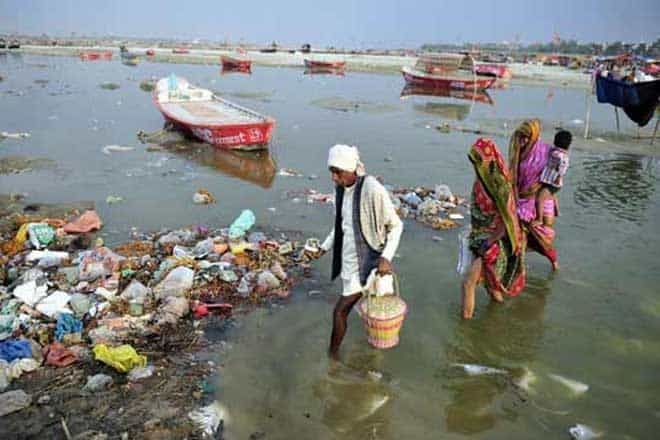
According to an assessment conducted by the Central Pollution Control Board (CPCB), the number of polluted river stretches has increased from 302 to 351 in the last two years. Stretches with the poorest water quality have also increased from 34 to 45.
The CPCB measures quality of rivers through the BOD (Biochemical Oxygen Demand) indicator – The higher the BOD, the more polluted the river. To be classified ‘healthy’, the BOD of the river has to be less than 3mg/l. A river with a BOD more than or equal to 30mg/l is ‘priority 1’ while that between 3.1-6 mg/l is ‘priority 5’.
Also Read:NGT Anguished Over Ganga’s Condition, Says Water Unfit To Use
While the central government has undertaken a massive Rs 20,000 project to clean up the Ganga, it is a far less polluted river, classified as priority 4. There are many other rivers which are much more polluted. Maharashtra, Assam and Gujarat account for 117 of the 351 polluted stretches, reported The Hindu.
The most seriously polluted stretches include Mumbai’s Mithi river’s stretch from Powai to Dharavi (BOD 250 mg/l), Godavari’s stretch from Someshwar to Rahed (BOD 5.0-80mg/l), Sabarmati river’s stretch between Kheroj and Vautha (BOD 4.0-147 mg/l) and Hindon river’s stretch between Saharanpur to Ghaziabad (BOD 48-120 mg/l).
A Union Water Resources Ministry official, who did not want to be identified told The Hindu, “The cultural significance of the Ganga is such that there’s been greater focus on it but many more rivers are far more polluted.”
Also Read: Clean Ganga Mission a major fail: Only 20% of Rs 20,601 crore fund utilised