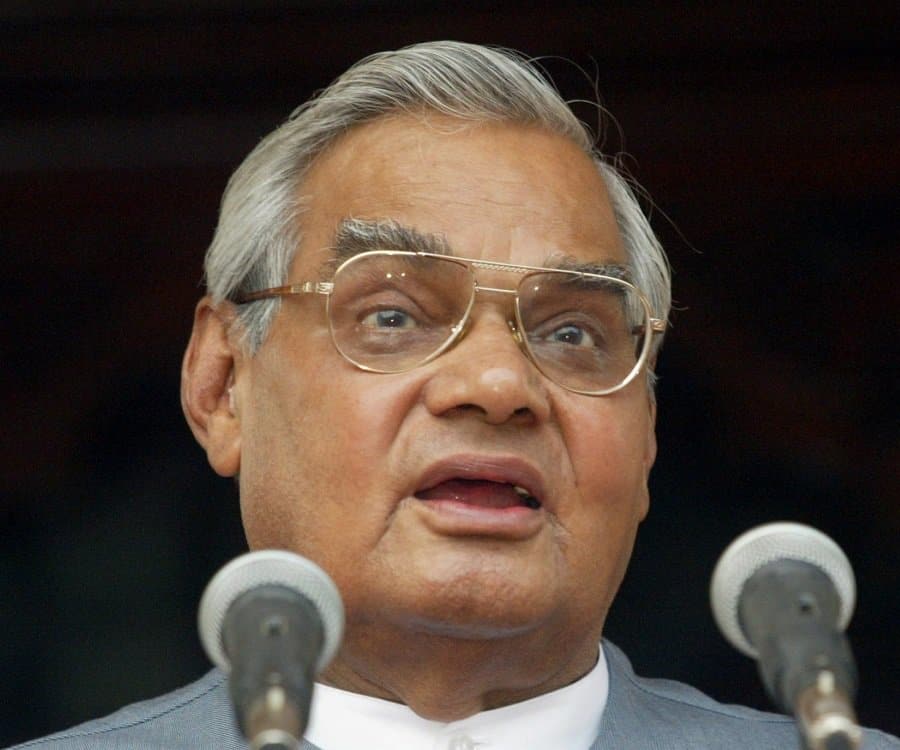
“Statesman” for some, “Mukhauta” for others, former Prime Minister Atal Bihari Vajpayee passed away at 5.05 PM on 16 August in New Delhi’s All India Institute of Medical Sciences. He was 93. On the last day of his life, he was visited by leaders from across the political spectrum – from Prime Minister Narendra Modi and BJP President Amit Shah to Opposition leaders like Congress President Rahul Gandhi, West Bengal Chief Minister Mamata Banerjee, former Chief Ministers of Jammu and Kashmir Farooq Abdullah and Omar Abdullah and Odisha CM Naveen Patnaik, among others. In many ways, this was symbolic of Vajpayee’s career as a politician – a man who had friends across political parties and very few enemies.
“Statesman” is an adjective that got stuck with Vajpayee, especially after the end of his Prime Ministership. But different sections saw him as a statesman for different reasons. For committed BJP supporters, he was an icon who brought the party to power for the first time in its history. For many liberals, Vajpayee was seen as a moderate compared to first LK Advani and more recently Narendra Modi. For many Kashmiris who had seen New Delhi as an adversarial entity, Vajpayee represented a voice of relative decency.
On the other hand, many also saw Vajpayee as a “Mukhauta” (mask) taking off from the monicker given to him by Swadeshi Jagran Manch ideologue KN Govindacharya, who was then a BJP general secretary. Vajpayee’s critics say he helped normalise Hindutva in India and weakened secularism in the country.
However, neither adjective – “statesman” or “mukhauta” – help us understand Vajpayee’s politics. His political acumen which lay in his ability to appeal to different people in different ways and occupy a position of moderation while remaining within the Hindu right-wing framework.
Vajpayee had an uncanny ability of grasping where the centre of political gravity lay and modifying his statements accordingly. It was this skill that drove him in 1971 to compare the then Prime Minister Indira Gandhi as “Goddess Durga” after India’s defeat of Pakistan that led to the formation of Bangladesh. When he became the first president of the Bharatiya Janata Party in 1980, he advocated that the party must follow the path of Gandhian socialism. This was because he felt that the BJP could break Congress’ hegemony only by adopting some of the Congress’ politics. And when the United States attacked Iraq in 2003, Vajpayee is said to have pushed the Left Parties to take a strong position so that it could create the ground for India’s condemnation for the invasion.
This skill — of grasping which way public opinion is leaning — was Vajpayee’s greatest strength but also his weakness. While it often provided the ground for bipartisanship, it also made Vajpayee play to the gallery in the worst possible manner. Nothing symbolised this more than his speech before the demolition of the Babri Masjid in 1992.
“The Supreme Court has given us the right to perform karsewa. We can perform karsewa tomorrow and not be in violation of any SC judgment. Rather, we would be respecting it. But there are some sharp stones there, which we cannot sit on. Therefore, the ground there will have to be levelled,” he had said.
https://www.youtube.com/watch?
This speech showed how he had called for the demolition of the Babri Masjid. Vajpayee’s call was in fact more direct than any speech given by LK Advani. Yet it is Advani and not Vajpayee who is projected as the architect of the demolition.
This was also reflected in his contradictory positions regarding the anti-Muslim pogrom in Gujarat in 2002. When the violence was still on, Vajpayee addressed a press conference with the then Gujarat Chief Minister Narendra Modi and publicly told him to “observe his Rajdharma” and not discriminate among the citizens on the basis of religion. This was seen as an open rebuke to Modi.
Vajpayee is said to have wanted Modi to quit as Gujarat CM. But during the BJP national executive in Panjim in April 2002, Modi pulled off a “coup” over Vajpayee. He said that he would like to step down as CM but many of the delegates present began shouting in his support. It may or may not have been a staged protest, but it made Vajpayee understand that the BJP rank and file did not share his opinion on Modi. He immediately changed tack and launched a tirade against Muslims during his speech at the BJP conclave.
Referring to the Gujarat violence he said provocatively, Aag lagayi kisne? (Who lit the fire?). Aag faili kaise? (How did it spread)”. He further said that Muslims “ghul milkar nahi rehte” (they do not assimilate) and alleged that the community doesn’t live in peace in any country. ”
“In addition to religious studies, madrassas should also teach Muslims how to live in peace,” he had also said.
But a few months later, Vajpayee changed his position yet again. In June 2002, PM Vajpayee wrote a letter to Modi expressing doubts whether the state government was effectively taking care of the interests of the violence-hit areas. Perhaps, Vajpayee’s final conclusion on the matter, as expressed in his musings in 2004, was that the Gujarat pogrom did contribute to his defeat in the Lok Sabha elections that year.
With Vajpayee no more, the BJP is likely to launch a publicity blitzkrieg showcasing how Modi is the former PM’s true heir. But that would be ironic given their complicated history. It is strange that many of Vajpayee’s loyalists are either no longer in the BJP or have been sidelined by Modi and Shah. His niece Karuna Shukla joined the Congress in 2014. Ministers who were seen close to him – such as Yashwant Sinha and Arun Shourie – have become trenchant critics of the BJP under Modi and Shah.
His coalition partners like Telugu Desam Party, Biju Janata Dal and Trinamool Congress are no longer part of the NDA and another ally Shiv Sena is openly sulking. On the other hand, Vajpayee’s nemesis Subramanian Swamy, who had played a key role in bringing down the Vajpayee government in 1998 was brought into the BJP by Modi and Shah. And Yogi Adityanath, political heir of known Vajpayee baiter Mahant Avaidyanath, has been made the Chief Minister of Uttar Pradesh.
In a polity that has become increasingly polarised, Vajpayee doesn’t really have a political heir.