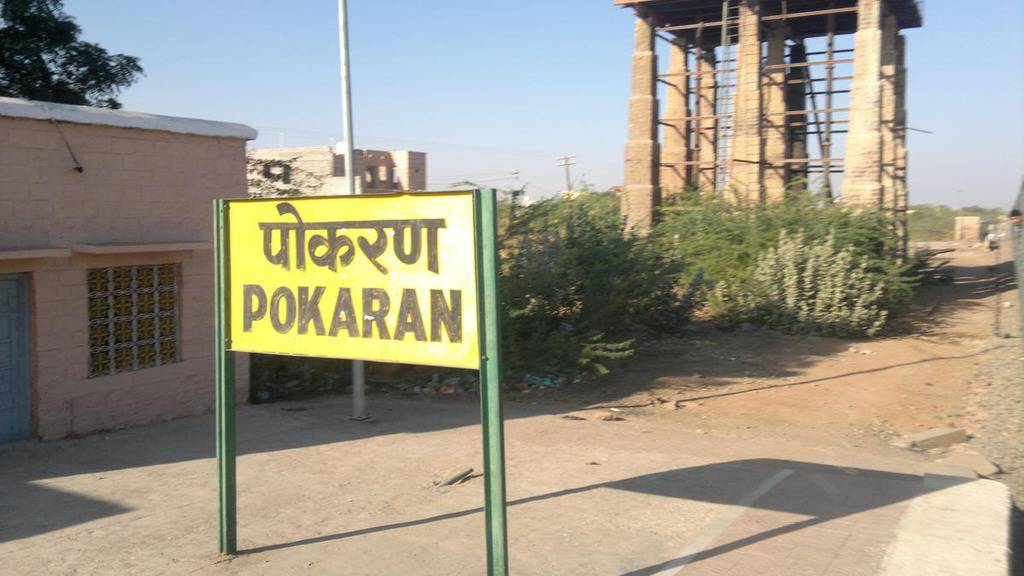
As one enters Pokaran, a town in Jaisalmer district that became famous as the site of India’s nuclear tests, one is greeted by a hoarding of local BJP MLA Shaitan Singh Rathore wishing people a “Happy Diwali”. The hoarding also says “Garv se kaho hum Hindu hain (Say with pride ‘We are Hindus’)”.
The parched condition of Pokaran is difficult to miss. The soil, the people, the lack of vegetation and even the visibly thirsty cows and stray dogs bear witness to the scarcity of water in the area. However, it seems that this time, the election in Pokaran won’t be about water but about communal and caste identity. It is being seen as a battle between a Mahant and a Sufi.
Hindutva card an attempt to withstand anti-incumbency mood
The poster didn’t quite work for Rathore as the BJP denied him a ticket this time, even though he had won in 2013 by a significant margin of over 34,000 votes. However, the BJP hasn’t discarded the Hindu card as it has fielded Swami Pratappuri Maharaj, the head of the Taratara Math that is located in the adjoining district of Barmer. BJP workers in Pokaran say that even though Rathore was a strong candidate, an even harder pro-Hindu line is needed for the party to win the seat.

The workers feel that as Pokaran is an important pilgrimage centre, voters will be receptive to the head of an influential math in the region. Several important temples are located in Pokaran tehsil such as the Ramdevra temple, Ashapura Mata temple and Balinath temple to name a few.
“Hindus must vote unitedly in Pokaran. The country is watching. Swami Pratappuri ji Maharaj can unite the community across castes like no one can,” said Mahendra Singh, a BJP supporter.
The Swami feels that his electoral battle is of national importance. “Not just Rajasthan, the whole of India is looking at Pokaran,” he said.
A Rajput like Yogi Adityanath, Pratappuri Maharaj is said to be inspired politically by the Uttar Pradesh chief minister. Not surprisingly, the BJP deployed Yogi Adityanath to sway votes in Pokaran and he addressed a rally in the town this Monday, the same day as Congress president Rahul Gandhi.
“The nuclear city is facing not just a test but a mega-test,” said Pratappuri Maharaj. He has accused the Congress of “communalising the election” by “fielding a Muslim”.
Pokaran is one of the few seats in Rajasthan where the BJP feels it can withstand the anti-incumbency mood, against the Vasundhara Raje-led state government, by changing the narrative to a “nationalism-centered” one or to a “Hindu vs Muslim” battle. Their target is a figure who has influenced politics in Western Rajasthan for over three decades now – Gazi Fakir, the spiritual leader of Sindhi Muslims who form around 30 per cent of the population in Pokaran and are present in substantial numbers in rest of Jaisalmer district as well as in Barmer.
Fakir is the Khalifa or representative of the Hur Sufi order of Sindh in Pakistan, headed by the Pir of Pagara. The current leader of the order is Syed Sibghatullah Shah Rashdi III or Pir of Pagaro the Eighth. Fakir’s son Saleh Mohammed is contesting from Pokaran on a Congress ticket. He had won the seat in 2008 but lost to the BJP’s Shaitan Singh Rathore in 2013.
Rivals have often accused Fakir of having links to Pakistan’s Inter Services Intelligence (ISI). However, the only evidence for this is the arrest on charges of espionage of a person named Sumar Khan who is said to have worked in a petrol pump owned by the Fakir family.
Gazi Fakir’s Influence
Another accusation that has often been made against Fakir is that he influences elections in Jaisalmer and Barmer districts based on directives from the Pir of Pagara. However, Fakir’s supporters say that the involvement of the Pir of Pagara is often overstated.

“He (Gazi Fakir) does tell the community who to vote for. But this is done keeping in mind the interests of the Muslim community in the region, not some directive from Pakistan,” said Saifuddin, who hails from a village near Pokaran.
Fakir’s “directives” aren’t always in favour of the Congress. In at least two elections – the 2003 assembly elections and the 2004 Lok Sabha elections, Fakir is said to have supported the BJP. This was largely due to his personal equation with BJP leader Jaswant Singh and his son Manvendra Singh who hail from Barmer. Some say Jaswant Singh had won Fakir’s support after meeting the Pir of Pagara during a visit to Pakistan.
Even in the 2014 Lok Sabha elections, Fakir supported Jaswant Singh in Barmer and not the Congress. Contesting as an independent candidate, Jaswant Singh came second, losing to Colonel (Retired) Sona Ram Chaudhary, who had defected from the Congress to the BJP just before the elections. Jaswant Singh, who is in a state of coma after meeting an accident in 2014, is said to have been “deeply touched” by the support given by the Muslims of Barmer and Jaisalmer at a time when he had been ditched by his own party.
Dalit-Muslim Alliance
Gazi Fakir’s political success is not so much due to factors from the other side of the border, but through the political and social alliances he has forged on this side. Fakir’s understanding with Jaswant Singh showed his flexibility to look beyond the Congress. But his political clout is built on the alliance he forged in the 1980s between Sindhi Muslims and the Meghwal Dalit community.

The Jaisalmer assembly seat had been a bastion of the Rajput community since Independence. Maharaja Hukum Singh of the Jaisalmer royal family won the seat twice, in 1957 and 1962. However, the community’s hold over the constituency was broken in 1985, when Gazi Fakir, Meghwal community leaders and a section of the Congress backed Multana Ram Barupal, a Dalit, who stood as an Independent candidate. Barupal won, defeating Congress candidate Bhopal Singh. The victory of a Dalit candidate in a Rajput-dominated general seat established Gazi Fakir as a force to reckon with in the region’s politics and sealed his alliance with the Meghwal community.
In the 1998 elections, the same Dalit- Muslim alliance led to the victory of Congress candidate Gordhan Das Kalla. When the party fielded Janak Singh instead of Kalla in 2003, the Meghwals and Fakir are said to have ensured the party’s defeat. It was around the same time that Jaswant Singh, then a prominent minister in the Union government, managed to secure Fakir’s support. When another Rajput candidate of the Congress – Sunita Singh Bhati – bit the dust in Jaisalmer in 2008, it became clear that only a Dalit-Muslim alliance can work for the party in the seat. In 2013, the party fielded Ruparam Dhandev, a Dalit and a respected official of the water works department, who got the full support of Gazi Fakir. Despite a BJP wave, Dhandev put up a good fight, losing to sitting BJP MLA Chhotu Singh by less than 4000 votes.
This time, the Congress is banking on a Dalit-Muslim alliance by fielding Dhandev from Jaisalmer and Fakir’s son Saleh Mohammed from Pokaran. Dhandev’s candidature faced some opposition from Sunita Bhati and a few other local party leaders from the Rajput community. The BJP has fielded former MLA Sang Singh Bhati, who had won the seat in 2003.
However, Gazi Fakir’s support for Dalit candidates is just one part of the story. Sindhi Muslims and Dalits are said to have often closed ranks even when it comes to local disputes.
“Rajputs often bully us and they beat us up if we refuse to do menial chores for them. Muslims have always supported us,” said Rakesh Meghwal, a resident of Jaisalmer.
This bonhomie was threatened last year when a Dalit girl was allegedly raped by a Muslim in Barmer. But even then it was a Muslim clairvoyant who reportedly helped catch the alleged rapist. Local Muslim lawyers refused to represent him. When a few Rajput activists reportedly began giving the issue a communal colour, the girl’s family said that they have no ill-will towards Muslims.
“In most atrocities, it is the Rajputs who are involved. This was the first time that a Muslim committed such an act. The Rajputs suddenly started protesting. If they care so much about us, they should ask their own men to stop harassing us,” Rakesh Meghwal said.
There is an ideological dimension to the Dalit-Muslim solidarity in Jaisalmer and Barmer. Both Meghwals and Sindhi Muslims are part of religious cults that were essentially based on fighting social inequality in a deeply feudal region. Meghwals are devotees of Ramdev Pir, a folk deity who is said to have lived in the 14th century. The Meghwals worship Ramdev Pir as a “demolisher of caste”. His most prominent temples are the Ramdevra Temple near Pokaran and the Tando Allahayar temple in Sindh. While locals consider Ramdev Pir to have been a Rajput prince, some Pakistani scholars have held that he could have been of Nizari Ismaili origin. The Muslims in the region also have deep respect for Ramdev Pir and the reason is the same as the Meghwals – his status as the “one who brings social equality”.
The Hur order to which Gazi Fakir belongs, has a similar character. Hur in Arabic means “free” or “not a slave”. In the 19th century, the Pir of Pagara declared his community as “Hur” or free of British slavery. The Hurs fought the British and were labelled a “criminal tribe” by the colonial government in 1898. Now 120 years later, the Sindhi Muslims of Western Rajasthan are similarly being projected as the antagonists in a battle being fought on the plank of nationalism and Hindutva.
The tussle in the region is for the votes of the Meghwal community. The Congress hopes that Gazi Fakir and Ruparam Dhandev are able to preserve the Dalit-Muslim alliance. On the other hand, the BJP hopes that its candidate Pratappuri Maharaj and star campaigner Yogi Adityanath succeed in making the Meghwals vote as Hindus.