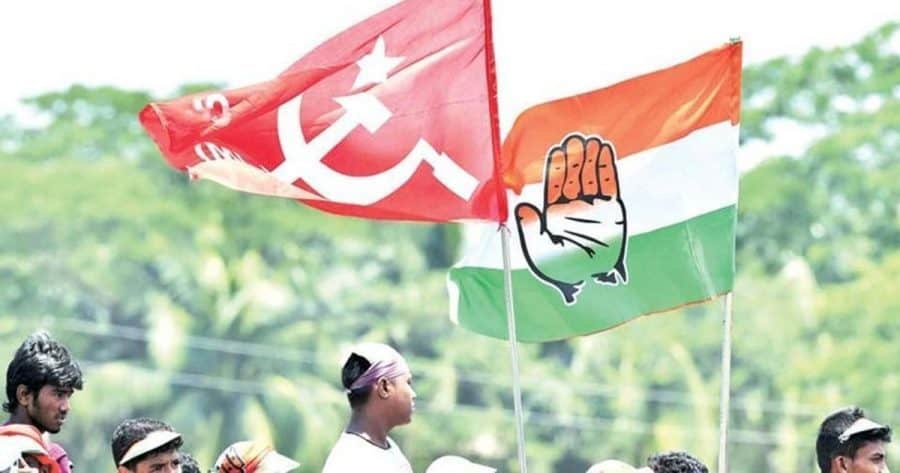
The nation is drifting into general elections mode. The Bharatiya Janata Party and its think tanks led considerable discussions, testing the waters to decide whether to advance general elections or not. The Mood of the Nation survey, periodically conducted by CSDS, became a reflection point that forced the BJP and Modi to walk back from advancing the elections. To finalise its strategy for general elections, the BJP also wants to test its mettle in the forthcoming assembly elections. The same is the case with the Congress – the only pan Indian opposition party that can take on BJP in each constituency unless restrained by its alliance tactics. Similarly, after these two, CPI(M) is the only party which can put up its candidates at least in 100 constituencies irrespective of the votes it command. It would interesting to see what would be the electoral tactics of CPI(M), the third largest pan Indian Left Party, which decided BJP as its enemy number one.
If we consider the electoral tactics opted byCPI(M) in its relatively strongholds of Rajasthan and Telangana for the upcoming assembly elections, it is doubtful whether the Party wants to stick to its understanding hammered out at the 22nd Congress held in Hyderabad. The Party Congress recommended for a tactical approach that includes Congress under the wings of all-in-one opposition unity. But the developments in since then does not appear to be as simple as that for the people steering in policy at Polit Bureau and Central Committee level. As the news reports appeared at the time of the Party Congress itself, the General Secretary, who got opportunity to present minority resolution before the delegates, second in the history of the Party, though increased his support base within the Polit Bureu, the key policy making body, that is not of much impact. As it appears, he used to wage a lone battle on each and every time the PB meets on various issues, be of policy matters or organizational issues. In such a situation, it is not easy for him to implement the understanding arriving at Party Congress.
The major impediment in implementing the Party Congress resolution on tactical line would be from Kerala lobby. It is a known fact that in Kerala, both CPI(M) and Congress are spearheading two coalitions that takes each other head on. When we analyze the data from the following table it is clear that at no point in time the vote share of CPI(M), as individual entity, crossed 25% in assembly elections. As the data reflects, the number of seats contested by CPM kept on growing from 65 in 1991 to 85 in 2006 assembly elections. But except, in 2006, between CPI(M) and Congress, the later used to command a vote share of nearing about 30 % constantly where as CPI(M) holds command on 20% of vote share constantly.
Despite its hold over 20% of vote bank for itself, CPI(M) could only come to power when it stitched alliance. As it is clear by now, among the Left Democratic Front, the CPI(M) is only the party that is on expanding mode at the cost of other allies, keeping in view assembly constituency wise rivalries an organisational issues. In such a case, unless it expands its social base among voters belongs to both Christian and Muslim minorities it is difficult for the CPI(M) to hold on to its position. The rise of BJP in terms of its vote bank is constantly in sink with its position in national politics.
In 2001, when NDA I was in power, BJP contested on 123 assembly constituencies and garnered 5 per cent votes. By the time of 2006 assembly elections, the BJP was in opposition in Centre and its vote share is reduced slightly. That election was pulled off by CPI(M) on the popularity of VS Achuthanandan despite he was humiliated by Prakash Karat camp both in Polit Bureau and Central Committee by not allowing him to contest. Surprisingly, in 2006 when the CPI(M) was still an ally of the UPA led by Congress, it got highest number of seats in Kerala assembly elections notching up its hold over 30% vote bank for the first time despite Congress and its splintered group Democratic Indira Congress led by former Chief Minister Karunakaran fought together with CPI(M) and BJP retained its vote bank at 6%. By 2011, the relations between CPI(M) and Congress became sore. In that assembly election, again CPI(M) leadership played with VS Achuthanandan candidature and still could hold its vote share by 28%.
It is interesting to look at the data for 2016 elections. Now, the BJP is in power in the centre and CPI(M) fell out with Congress completely for about a decade. Though CPI(M) regained power from the Congress, when we look at the voting share commanded by each party, we can say that BJP doubled share. Another important fact to be noted here is that it is the Congress vote share shifted towards BJP where as CPI(M) could retain its position. This is the key deviating factor on which the CPI(M) has to decide its political tactical line for forthcoming general elections. When BJP was in power in 2001 and CPI(M) fought alone in Kerala it could only command 21%. When CPI(M) was an ally in Center under UPA regime and was in straight fight with Congress in Kerala for 2006 assembly elections, its vote share rose to 30.4%. Again when CPI(M) fell out with Congress and took on it head on, its vote share further depleted by 2%. And by 2016, the CPI(M) vote bank is further down to 26.7%. The vote share of BJP rose from 4.7% in 2006 to 10 % in 2016. In that sense it is Congress that was stagnated its vote share and the upper caste Hindu’s are shifting their allegiance towards BJP. In such a situation, unless the CPI(M) decides to take on BJP at national level and determined to dislodge it from power, it is difficult to retain its position as leader of the progressive secular and democratic forces in Kerala. Will the Party high command read the writing on the wall ?
EOM
|
CPI(M) Vs Congress Performance in Kerala Assembly Elections |
||||||
|
Year |
Contested |
Won |
Runner Up |
Votes Polled |
% Secured |
Party |
|
2016 |
84 |
58 |
23 |
53,65,472 |
26.70% |
CPM |
|
|
47,94,793 |
23.80% |
INC |
|||
|
2011 |
84 |
45 |
38 |
49,21,354 |
28.40% |
CPM |
|
|
81 |
38 |
43 |
46,10,328 |
26.4 |
INC |
|
2006 |
47,32,381 |
30.40% |
CPM |
|||
|
|
77 |
24 |
53 |
3744784 |
24,10 |
INC |
|
|
6,64,159 |
4.30% |
DIC |
|||
|
2001 |
49,40,883 |
31.40% |
INC |
|||
|
|
33,61,827 |
21.40% |
CPM |
|||
|
1996 |
30,78,723 |
21.60% |
CPM |
|||
|
|
43,40,717 |
30.40% |
INC |
|||
|
1991 |
91 |
55 |
36 |
45,46,379 |
32.10% |
INC |
|
|
31,29,523 |
22.10% |
CPM |
|||
Y Venugopal Reddy was former state committee member of SFI and is now practicing as advocate in the Hyderabad High Court.