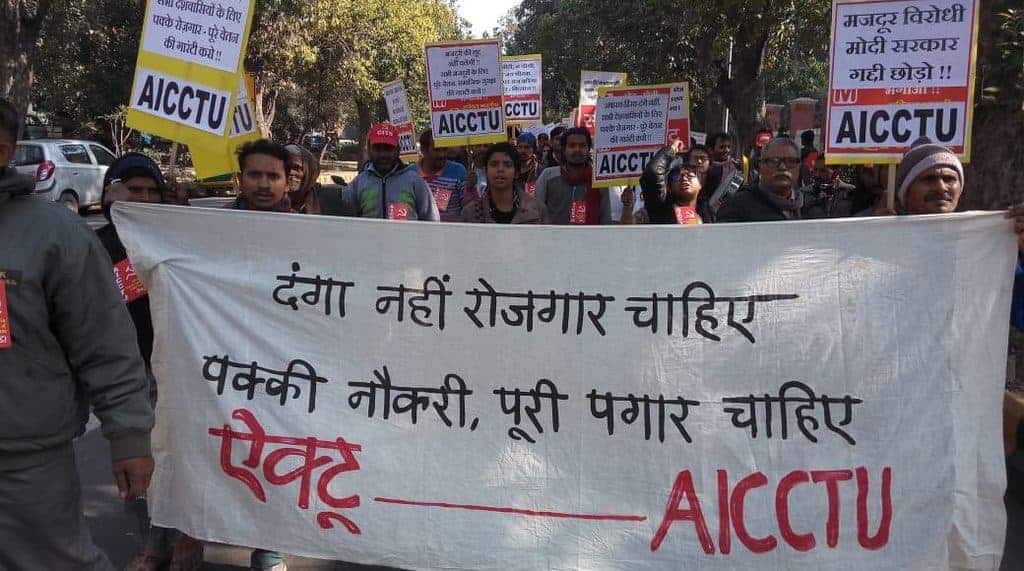
Chanting “Wazirpur is closed today, will remain closed”, a rally started at around 10 am in New Delhi’s Wazirpur area. Without obstructing traffic, workers took out similar rallies in Narela, Badli, Bawana and Nangloi and other industrial areas of NCR region. The Bharat Bandh called by the All India Central Council of Trade Unions (AICCTU) was supported by ten other trade trade unions. It is noteworthy that workers from both the organised and unorganised sector participated in the strike with much enthusiasm.
Mala Gautam, affiliated with the All India Bank Employees Association (AIBEA), told NewsCentral24x7, “All of us bankers are on a two-day strike. If the Modi government does not stop interfering with the functioning of banks, we will continue protests in the future.” Along with AIBEA, Bank Employees Federation of India (BEFI) also observed the two-day strike.
Modi government’s amendments to the Trade Union Act, 1926 remained the focal point of the workers’ agitation. By way of the amendment, the central government has usurped the right to recognise trade unions. Unions have opposed this amendment and have labelled it a conspiracy to interfere with the functioning of trade unions. 10 out of 13 trade unions have registered their protests with the amendment by writing to the Ministry of Labour and Employment.
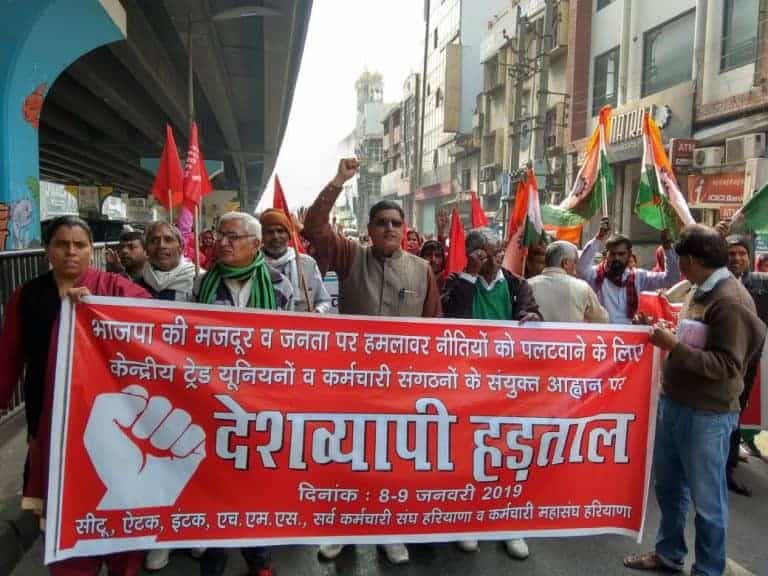
While the Bhartiya Mazdoor Sangh, affiliated with the BJP-RSS, distanced itself from the strike formally, its workers were seen participating in the processions independently. One Karmakar told NC24x7, “Modi government has washed away our hopes. It has turned its back on all the promises made. The state of agriculture is such that people are quitting farming and coming to factories, but there are no jobs at the factories either. If there are jobs, there are no dignified wages.”
Commenting on BJP-affiliated trade union workers joining a strike called by left unions, he said, “On one hand this is an expression of the disillusionment with the BJP and on the other, it is a warning to the leaders of our union that they should not collaborate with the establishment against the interests of workers.”
Amendments to labour laws has been on the BJP agenda, since it came to power in 2014. In July 2015, at the 46th Indian Labour Conference, the Prime Minister had said, “As part of the concept of minimum government, maximum governance, obsolete and unnecessary laws are being weeded out.” Several BJP state governments have diluted the existing provisions for the protection of the rights of workers.
AICCTU in-charge in the Wazirpur Industrial area, Mathura Paswan told NewsCentral24x7, “Even with the existing labour laws, employers harass workers so much. If the Modi government dismantles these laws, we will become slaves to factory owners. We have to stop the government from doing this.”

Protesting workers in Delhi complain that pollution has also affected their employment status. The workers’ agenda includes Delhi government’s anti-worker policies in the name of pollution control. Sher Mohammad, who was leading the demonstration in Okhla Industrial Area, told NewsCentral24x7, “Every other day, in the name of controlling pollution, work (industries and construction) is halted. Due to this reason, it has become extremely difficult to live and work in Delhi. Workers from Bihar, West Bengal, Uttar Pradesh and Jharkhand come to Delhi in search for work. But the government does not care about us. All of their measures of pollution control are coming at the cost of our livelihoods.”
By way of amending labour laws, the government is trying to signal to corporates that an environment conducive to ‘ease of business’ is being created. On the other hand, the workers and trade unions are continuing the struggle to demand basic rights from the governments.
To read the full story in Hindi, click here.