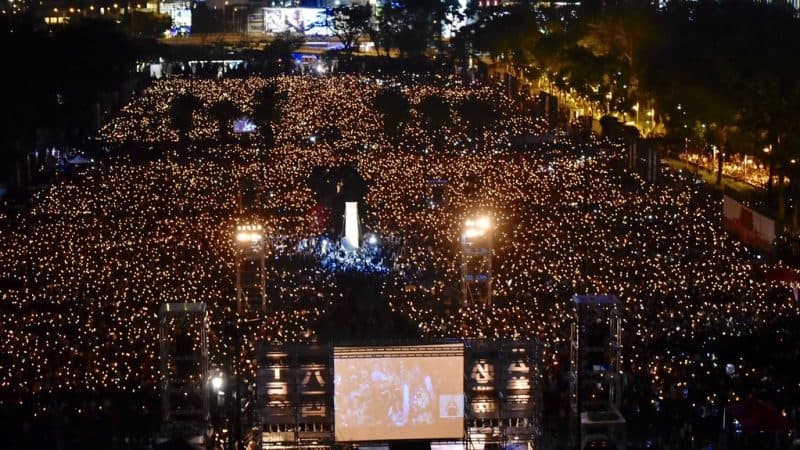
Thousands of Hong Kongers attended a candlelight vigil to commemorate the 30th anniversary of the Tiananmen Massacre at Victoria Park on Tuesday night. This collective act of remembrance has turned into a ritual for the past 30 years, as many Hong Kongers keep honoring the spirit of China’s democratization, as well as the high price some paid for it on June 4, 1989.
The Chinese government continues to claim that the democracy movement led by students in Beijing in 1989 was a riot manipulated by foreign forces. The 50 day-long peaceful protest ended with a military crackdown on June 4, 1989. According to a Chinese Red Cross estimate, 2,700 civilians were killed, but other sources point to a much higher toll. A confidential U.S government document unveiled in 2014 reported that a Chinese internal assessment estimated at least 10,454 civilians had been killed.
Within China, the June 4 incident, as it is described, has been a political taboo for 30 years. The majority of the young generation has never heard about the military crackdown, as it has not been reported on in newspapers. Similarly, online discussions about the events have been and remain censored. This year, the Chinese Communist Party (CCP) affiliated news outlet Global Times described such censorship practice as a “political success”, as it has turned the June 4 incident into “a faded historical event rather than an actual entanglement”.

Hong Kong has been the most significant site within China in preserving the memories of June 4. The organizer of the annual candlelight vigil, the Hong Kong Alliance in Support of Patriotic Democratic Movement in China, has also established a June 4 Museum in the city in 2014.
Every year, the organizer also provides an update on the actual documentation of the victims of the Tiananmen Massacre, given that the Chinese government blocks any inquiries. The update is done by the Tiananmen Mothers — a civilian group composed of families of the victims. Despite ongoing harassment, surveillance and threats, the group has so far collectively identified and documented 202 individuals killed in the June 4 crackdown.

Former reporters and students who were in Tiananmen Square during the crackdown also shared their testimonies. During the candle night vigil, former student activist Liane Lee gave her first public testimony on stage (Chinese transcript via the Initium):
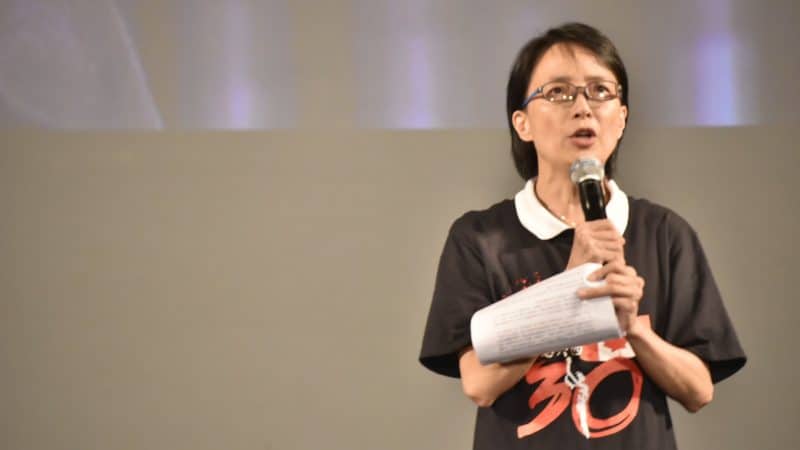 Lee Lan Ko via inmediahk.net (CC: AT – NC)
In mainland China, the official political narrative describes the June 4 military crackdown as a necessary step to preserve the One-Party system, as reflected in the Global Times’ latest commentary:
The Chinese government’s control of the incident in 1989 has been a watershed marking the differences between China and former Eastern European socialist countries, including the Soviet Union and Yugoslavia. Since the incident, China has successfully become the world’s second largest economy, with rapid improvement of people’s living standards. The policy of avoiding arguing has served as a contributor to the country’s economic take-off.
In such political context, the people’s memory of June 4 has become a “crime”, as depicted by lyrics of the song, Memory is a crime composed by local pop singer Anthony Wong to commemorate the 30th anniversary of the Tiananmen Massacre.
Anthony Wong performed on stage during the candle vigil and urged the people of Hong Kong to speak up against the amendment of the city’s extradition law and to join an upcoming protest on June 9.
The spirit and the courage to remember are well preserved by the sea of candlelight. According to the organizer of the vigil, 180,000 people came to commemorate the 30th anniversary of the Tiananmen Massacre, breaking the record set in 2014.
This article was originally published on GlobalVoices and has been republished under the Creative Commons license.