In his latest in the series of investigations on the Rafale Deal, N. Ram has reported in The Hindu that the Cabinet Committee on Security (CCS), led by the Prime Minister, gave “exceptional” and “unprecedented” waivers to M/s Dassault Aviation and M/s MBDA, in the offset contracts. The Indian government signed these contracts on September 23, 2016 as part of the Rafale deal worth 7.87 billion euros.
Following are the key revelations made by the report.
- These waivers granted on August 24, 2016 by the executive to the French companies, were exemptions that exempted them from complying with provisions of the Standard Contract Document of the Defence Procurement Procedure, DPP-2013.
- The waivers concerned two key issues — the provisions to be made in the offset contracts for arbitration (Article 9) and access to books of accounts of the industrial suppliers (Article 12).
- Following this, the information of granting these waivers had been sent up to the CCS for its “final review and approval” by the Defence Acquisition Council (DAC), headed by the then-Defence Minister, Manohar Parrikar. Reportedly, Parrikar had “evidently felt uncomfortable” with sanctioning, at his level, that led to major deviations from the Defence Procurement Procedure.
Also Read: Rafale Parallel Negotiations By PMO Weakened India’s Negotiating Team: Defence Ministry Note
- But, per the report, it did not end here. Apart from this, two other mandated provisions of DPP-2013 that prohibit the “Use of Undue Influence” and “Agents/ Agency Commission”, Articles 22 and 23 respectively of the Standard Contract Document, and provide for penalties against private industrial suppliers in case of transgressions, had been inconspicuously dropped along the way by the DAC.
- Further, while the deletion of these pertinent integrity provisions from the Supply Protocols went up to the CCS for “final review and approval”, their deletion from the offset contracts, which had been insisted on by the French industrial suppliers, did not have to.
These crucial facts, writes N.Ram, were not disclosed by the government in its submissions to the Supreme Court of India when the case was heard, and along with it, other aspects of an open-ended and deliberately unclear set of offset arrangements were enabled by a major change in offset policy in August 2015. These are revealed in the final report of the Indian Negotiating Team (INT), dated July 21, 2016, to which reportedly The Hindu has access.
- Laconically, the report explains, offsets are ‘domestic content-based requirements’ that the importing government imposes on the exporting foreign agency. There has reportedly been a major political controversy over Dassault Aviation’s choice of Indian Offset Partners (IOPs), notably Anil Ambani’s Reliance Group, and the non-transparent arrangements for the discharge of offset obligations.
- The total offsets to be delivered in the Rafale deal by Dassault Aviation (and its 21 Tier-1 sub-vendors) together with MBDA (and its 12 Tier-1 sub-vendors) have been fixed at 50% of the contract value.

- The contracted offset obligations, which are valued around ₹30,000 crore, are to be discharged over a period of seven years beginning in the fourth year, that is, from October 2019 – implying thereby, that for the first three years, the offset obligations are valued at 0%. According to the offset schedule per the report, the two private French companies (along with their Tier-1 sub-vendors) will discharge 0% of the value of the total offsets for ‘Make in India’ in the first three years and 4% in the fourth year.
- Reportedly, the discharge of offset obligations is heavy in the last two years of the seven-year period. While Dassault (and its Tier-1 sub-vendors) will discharge 16% and 23% of the value of offsets in years five and six, the corresponding figures for MBDA (and its Tier-1 sub-vendors) will be 9% and 30%. No less than 57% of the value of total offset obligations will be discharged in the seventh year.
Also Read: There May Be Vindictive Action Like Denying Advertisement: N Ram on The Hindu’s Rafale Investigation
- The INT’s final report reveals that the initial proposal of Dassault Aviation and MBDA had nearly 88% of offset obligations loaded on to the seventh year.
- The avenues proposed for offset discharge were also “far from satisfactory.” A meeting held in the Defence Ministry on January 4, 2016 decided that in view of advice received from the Ministry of Law and Justice, the French side should be informed that the offsets “will have impact on the commercial proposal” and that the French industrial suppliers should be advised to submit revised offset proposals urgently.
- N. Ram has further explained that the INT report reveals that the French negotiators were initially “not ready to mention the word ‘offsets’ in the IGA” but upon insistence by the Indian side, they “relented and added ‘Make in India’ initiative through Offsets at Article 12 of the IGA”.
- The proposal originally submitted by Dassault Aviation and MBDA was reportedly titled ‘Rafale Make in India initiative in the frame of the procurement of 36 Rafale aircraft’. This “neither mentioned the word ‘Offset’ nor provided the desired avenues/percentages/yearly discharge, etc., as mandated by the DPP-2013 guidelines”. It was only after deliberations that the two industrial suppliers agreed to provide their offset offer “as per the format specified in DPP-2013”.
- The INT report, as cited in The Hindu, also notes that certain Articles of the offset contracts “were not consistent with the standard contract document provided in DPP-2013. Specifically, the French side was not ready to include the Articles on ‘Arbitration’, ‘Use of Undue Influence’, ‘Agents and Agency Commission’, ‘Access to Book of Accounts’ and ‘Offset Performance Bond’.”
Also Read: ‘Cover Up’: N Ram on Modi Govt’s Defence of Rafale Deal (Watch)
- While Dassault Aviation and MBDA reportedly proposed the inclusion of the same clause on arbitration in the offset contract as in the IGA, the Indian negotiators contended that the IGA formulations could not be applied to the offset contracts, which would be signed directly by the Government of India with the two industrial suppliers.
- The offset contracts were clearly not part of the IGA, the report adds. Acting on directions from the DAC, the INT repeatedly pressed the French side to` agree to the alignment of Article 9 of the offset contract with Article 21A of Chapter V of the Standard Contract Document of DPP-2013.
- But Dassault Aviation and MBDA did not budge, citing three reasons, as quoted in The Hindu: “(i) Simple and efficient wording; (ii) Agreed by both governments; (iii) No confusion or risks of overlap in Arbitration procedure for any dispute spreading from the Supply Protocols to the Offset Contract.”
- The INT’s efforts on this issue had been weakened, if not undermined, by the parallel talks conducted by the National Security Adviser, Ajit Doval, in Paris in January 2016. N. Ram writes, “the Indian negotiators found themselves up against a wall.”
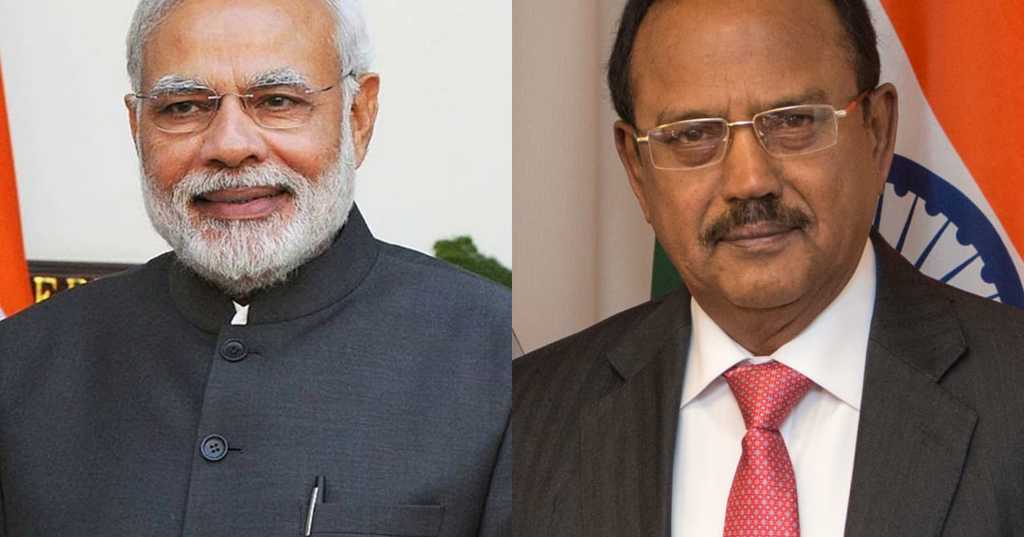
PM Modi (L) and National Security Adviser Ajit Doval - Eventually, in July 2016, two months before the Rafale deal was signed, the DAC decided to send the issue of the lack of alignment of Article 9 — the arbitration provision in the offset contracts with the French industrial suppliers — with the mandated DPP-2013 provisions to “the government”. On August 24, 2016, the Cabinet Committee on Security decided to give a waiver on this issue to the two French companies – undertaking major deviations from the standard procedure.
- The INT report reveals that although the French side agreed to have a provision on ‘Access to Book of Accounts’ (Article 12) included in the offset contracts, it brought in France’s controversial blocking statute which criminalises the communication of economic, commercial, industrial, financial, or technical documents or information to foreign individuals – and reportedly insisted that “they are bound to consider the French law as stated”.
- According to The Hindu, in July 2016, the DAC directed that “Article-12 of the Offset Contract on ‘Access to Book of Accounts’ which has been aligned with the Mirage 2000 MLU Contract, may be placed for a decision by the Govt”. Reportedly, this waiver was also approved by the CCS on August 24, 2016.
- It is important to note, the report emphasises, that the offset contracts, which were concluded between the Government of India and the two private French companies, were not part of the Indo-French Inter-Governmental Agreement. Although signed on the same day, September 23, 2016, as the IGA, the two offset contracts were completely separate from it.
- This crucial fact was reportedly brought up in the official talks by the Indian Negotiating Team with a singular lack of success, mainly because their efforts had been undermined by the “parallel negotiations” conducted by officials of the PMO and the NSA Ajit Doval.
What will remain under scrutiny, N.Ram writes, is the controversy over Dassault’s choice of offset partners. As has been widely reported, Anil Ambani’s Reliance Group, with its subsidiaries, entered the defence manufacturing sector in January 2015 – and was incorporated on March 28, 2015, that is, two weeks before the new Rafale deal was announced in Paris. Reliance Aerostructure Limited (in which Reliance Defence Limited was a 99.988% shareholder as of March 31, 2018), was incorporated on April 24, 2015. A joint venture was incorporated in February 2017 between Dassault Aviation and Reliance Aerospace – a subsidiary of Reliance Aerostructure Limited.
The allegations, as the report highlights, revolve round the charge of “crony capitalism”– led by Congress president Rahul Gandhi that, as a quid pro quo for the new Rafale deal, the NDA government had secretly nominated Anil Ambani as Dassault’s leading offset partner. The allegations have been denied by Dassault Aviation, by Anil Ambani, and by the NDA government, which has maintained that it has had nothing to do with the aircraft manufacturer’s choice of IOPs and has not even received official word on who they are.
The role of Reliance or other Indian companies or the DRDO, as N. Ram writes, will be clear only in years to come. But based on INT report and the investigation, what has come to the fore is that a group that entered the defence manufacturing sector some weeks before a new Rafale deal was announced in Paris is the only publicly known offset partner.