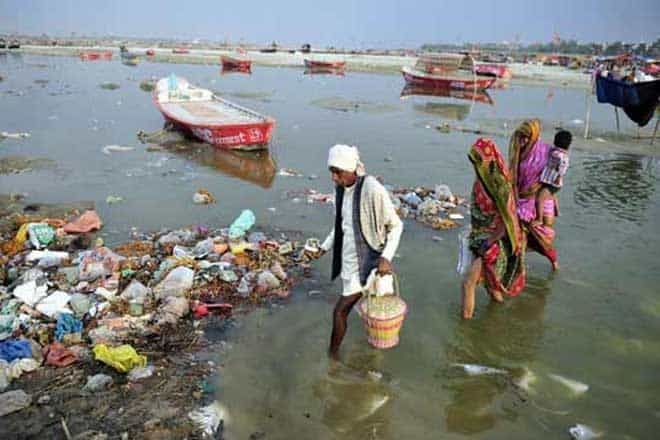
The Namami Gange Programme introduced by the Narendra Modi led-Bharatiya Janata Party (BJP) government to clean and conserve the river Ganga has failed to achieve the set target as per a report by Binay Singh in the Times of India.
Reportedly, contrary to the goals of the Rs 20,000 crore-project, an analysis of the data collated by a Varanasi-based organisation Sankat Mochan Foundation (SMF) reveals that there is a significant rise in coliform bacteria and biochemical oxygen demand (BOD) in the water of the Ganges. These are two of the most important parameters to evaluate water quality.
Launched in 2014 by PM Modi, after disbanding the National Ganga River Basin Authority (NGRBA) — set up in 2009 by the Dr Manmohan Singh-led UPA government — the Namani Ganage Programme aimed to achieve “nirmalta” (purity) of the Ganges by 2019. According to the ToI report, however, Union Minister Nitin Gadkari last year extended the deadline to March 2020.
The SMF, per the report, has been conducting quality checks in the water since 1986, after the launch of the Ganga Action Plan by then Prime Minister Rajiv Gandhi. The SMF has its laboratory that keeps a tab on the quality of the water and is regular in analysing samples. According to ToI, data recently collected by the laboratory points to a massive rise in pollution levels due to high bacterial pollution.
Also read: Ganga Activist’s Death: Rahul Gandhi Vows To Take Fight For Clean River Forward
The coliform organisms count, per the report, should ideally be 50MPN (most probable number) in 100ml or less in drinking water and 500MPN in 100ml in outdoor bathing water. The BOD, the report emphasises, should be less than 3mg/l. However, according to SMF data shared by ToI, faecal coliform count rose from 4.5 lakh (upstream at Nagwa) and 5.2 crore (downstream in Varuna) in January 2016 to 3.8 crore (upstream) and 14.4 crore (downstream) in February 2019.
SMF president, IIT-BHU professor and mahant of the Sankat Mochan temple, VN Mishra told the ToI that like the coliform levels, the BOD levels too underwent a notable increase in levels. “Similarly, BOD level has risen from 46.8-54mg/l to 66-78mg/l during January 2016-February 2019. Besides, the level of dissolved oxygen (DO), which should be 6mg/l or more, has gone down from 2.4mg/l to 1.4mg/l during this period. The high presence of coliform bacteria in Ganga water is alarming for human health,” he said.
Scientist and eminent environmentalist BD Tripathi told the ToI that E Coli, the species of coliform bacteria is an indicator of faecal pollution in the water. He said, “Faecal coliform is present in the gut and faeces of warm-blooded animals. Consequently, E Coli is considered to be the species of coliform bacteria that is the best indicator of faecal pollution and the possible presence of disease-causing pathogens.”
Recently, environmentalist Rajendra Singh in an interview said that despite Narendra Modi’s 2014 campaign promise in Varanasi about cleaning the River Ganga, the river continues to be more polluted than ever. He added that all others who fight for a cleaner Ganga, and the Ganga itself, have too, been betrayed by the PM.
Also read: Ganges: Sewers Could be Making Water Quality of India’s Great River Worse