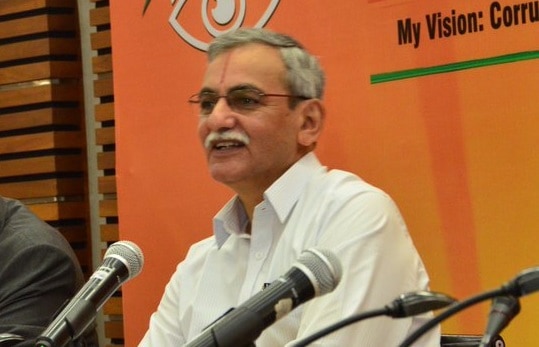
As the Supreme Court prepares to hear the case of CBI Director, Alok Verma on Monday, the dubious role of the Central Vigilance Commissioner (CVC), KV Chowdary, in the crisis has come under the spotlight. The superintendence exercised over the CBI by Chowdary, a former Indian Revenue Service (IRS) officer, will form an important backdrop of the apex court’s hearing and is set to raise fireworks.
The controversy surrounding Chowdary’s biased actions – ostensibly on behalf of the Modi government – had been highlighted by the Supreme Court’s unprecedented order to place the CVC under the supervision of a retired Supreme Court judge. Justice (retd.) AK Patnaik was nominated by a bench of the apex court, headed by CJI Ranjan Gogoi, to supervise, monitor and report on Chowdary’s role even though government’s counsel, Solicitor General Tushar Mehta, had argued that such supervision was not needed.
Also Read: The Modi Govt Either Lied About A CVC Note Against Asthana Or Is Now Hiding It
Chowdary has been under fire for some time now, and as per sources in his office, he seems to be on the defensive on the CBI matter now. His role in the two midnight orders issued by him on October 23, which were used by the government to push Verma out of India’s top investigation agency, has opened the proverbial can of worms.
To show that he was being even-handed against both officers, Chowdary passed two orders: one against Verma and another against his number two, Rakesh Asthana, who is named as an accused in the FIR in a bribery case by the CBI. The order against Verma was based on a flimsy complaint by Asthana, which CBI itself had noted, was based on a document forged by Asthana and his team.
But it is Chowdary’s order against Asthana, which has raised eyebrows in all quarters, and points to a possible collusion with the Modi government which found itself under pressure due to CBI’s investigations against Gujarat cadre officers. CVC order of October 13 against Asthana has relied on Verma’s secret note dated 21 October 2017, which had serious charges about Asthana’s alleged role in the Sterling Biotech corruption and money laundering case.
Also Read: Govt, CVC Were Hand In Glove In Action Against CBI Chief Alok Verma, Alleges Congress
It defies comprehension that this was the same note from Verma which was rejected by CVC Chowdary while considering Asthana’s appointment as Special Director of CBI. If Chowdary had taken it on record, Asthana – an IPS officer particularly close to Narendra Modi since his Gujarat days – wouldn’t have become Special Director of CBI looking after politically sensitive cases.
Even the Supreme Court had then noted that the “secret note of Director Alok Verma was unsigned, so CVC Chowdary did not take it on record and cannot be relied”. This was based on CVC’s minutes of the meeting, which rejected Verma’s secret note dated 21 October 2017 against Asthana and dismissed his plea. Supreme Court used this as the basis of its decision to dismiss Prashant Bhushan’s petition challenging Asthana’s appointment as Special Director of CBI.
How is it that the very same note, which was not considered by Chowdary while appointing Asthana to the post of Special Director was used to push him out of CBI a year later? If the charges in that note by Verma are now true, under what pressure did Chowdary dismiss them in 2017? The buzz in the CVC office suggests that Chowdary is completely in the control of senior Modi government officials, and by following their orders, he has put himself in the cross-hairs of the apex court.
This belief is further buttressed by the evidence of letters written by CBI to CVC Chowdary, warning him against inducting officers into CBI who were being investigated by the agency itself. In July, CBI wrote to CVC that The CBI said that it “in the previous CBI Selection Committee meeting, names of officers who were being considered for induction in CBI were under examination by the CBI as suspects/ accused in criminal cases under investigation with the Bureau”. It said that apart from a letter sent on July 6, “this was also formally conveyed in the previous CBI Selection Committee meetings as well as during the monthly meetings held between the CVC and the CBI”.
Also Read: SC Seeks Centre, CBI, CVC Reply On Verma’s Plea; CVC To Conduct Inquiry Within 2 Weeks
The agency had then noted that it “had already expressed its concern on May 18th, 2018 vide letter… wherein it was requested that CBI be given sufficient time in advance to conduct due diligence checks on the officers/ candidates being proposed for induction”. All this points to a dubious role played by Chowdary who now finds himself at the centre of an issue which has grabbed the attention of the Supreme Court. The monitor has himself ended up being monitored.
All eyes are now on the retired Justice Patnaik, whose monitoring of the monitor at the behest of the Supreme Court has added a further dimension to the debate over health of statutory institutions under the Modi government. The next few days will decide whether Indian institutions will mature or perish. We are at a breaking point in India’s history.