
If unpredictability has a face for itself in Indian politics, then it is of (Bahujan Samaj Party) BSP supremo and four-time Chief Minister of Uttar Pradesh, Mayawati. With just 4% vote share in general elections, she is the only pan-Indian face after Modi and Rahul Gandhi. After consecutive defeats in 2014, and then 2017 assembly elections, the tallest Dalit leader has a test of survival ahead of her. By 2017, she was left with just a little more than her Jatav vote bank. The Brahmins who had supported her in 2007 in UP had long deserted her, Muslims were dismayed by her inaction in the face of growing communal conflicts, and non-jatavs had been lured in the Hindutva kitty by the BJP. Her vote share shrunk to less than 20% in 2014 elections and sprung to a little more than 22% in the assembly elections. With the rise of new age Dalit leaders like Jignesh Mevani, and Chandrashekhar Ravan, her political end seemed closer. But come three by-polls in Uttar Pradesh, her alliance with Samajwadi Party, and we realise her power of transferring her loyal voter base.
So how is it that a party that has lost, and lost miserably, is still the most sought after in creating the anti-Modi front?
Political commentators have deftly built the narrative about her hold on her social base and her power of transferring her loyal vote base. And while this touted loyalty quotient of her vote base makes her a wanted ally, her unpredictability proves the limiting factor. In the upcoming assembly polls in the Hindi belt, she showed a taint of it when she dumped her possible alliance with Congress in the three states and formed an alliance with Ajit Jogi’s ‘Janta Congress’ in Chhattisgarh. However, Mayawati praised the Congress chief and Sonia Gandhi, while going hammer and tongs at Digvijay Singh, keeping doors to a possible alliance in the future open.
But in this whole act, has Mayawati punched a little more than her weight? Does this show her aloofness from the changing dynamics of Indian politics?
BSP’s shrinking vote base
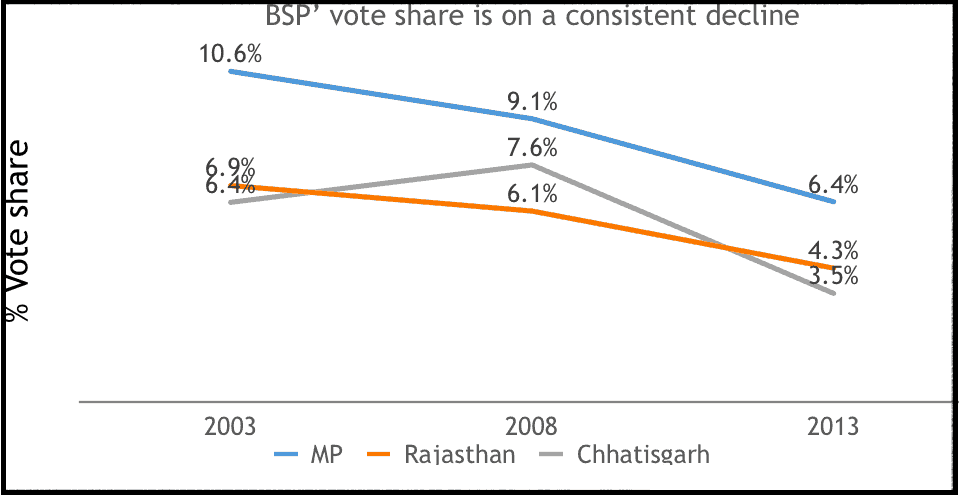
BSP’s support base in Madhya Pradesh, Chhattisgarh and Rajasthan has been in serious decline over the past few elections. In Rajasthan and Chhattisgarh, it has nosedived from around 6% in 2003 to just 4.3% and 3.5% in 2013. As elections get more two-party centric, this is set to go down further. In Rajasthan, BSP lost deposits in 182 out of 197 seats it contested in 2013. Since then, the party has shown no signs of revival in the state. Similarly, in Chhattisgarh, where the party lost deposits in all but six seats in 2013, it has remained dormant and issueless for the last five years. In a closely fought election, every vote shall matter, and thus even a small vote share of 3-4% counts as a dent.
But expecting that the party which has been on a decline — clearly not seen as one raising issues of its vote base, and completely out of touch of the regional politics — could make a huge impact, sounds more like a narrative sustained by commentators willingly overlooking the ground realities. This is true for other states too. In Punjab for instance, BSP’s vote share has dipped from 16.3% in 1992 to just 4.3% in 2017. In Uttrakhand, where BSP has enjoyed a good run in almost all elections, since the formation of the state, getting close to 12% vote share, the vote share dipped to a mere 7% in 2017. In all of these states, the party has been relegated to the far third space, which is continuously shrinking.
In Chhattisgarh, BSP may find a lease of life in Ajit Jogi’s Janhit Congress, which is said to still hold some tribal votes. But would the so anti-Raman Singh voter risk its vote on the newbie in the market? Largely, even when Ajit Singh was Congress’s face, he was seen to be in cahoots with Raman Singh. A large electorate considered Jogi the chief architect of Congress defeats in closely fought elections. In his new avatar, he might at the best act like a vote-cutter. And this very role that he expects to play, makes him the best bet for the BJP in Chhattisgarh.
Mayawati’s BSP does hold some sway in MP, especially around the Bundelkhand and Chambal region. But this also might prove a well-cultivated truth. This assertion too needs a fact check as well, as in these years, BSP has lost several leaders from this belt to the BJP. In 2017 UP elections, BSP fared bad in Bundelkhand, considered to be BSP’s stronghold, because of high presence of backward castes. Considering she would be able to hold her sway in the adjoining areas of MP, BSP could be a risky proposition to bet on. The adjoining areas of Gwalior, considered a bastion of Scindia who is still considered in the race for the top job, and Mandsaur has seen much heat. The political heat here could turn even the BSP voters in Congress’s fold.
A caste and community post-poll survey of the Centre for the Study of Developing Societies (CSDS) conducted after the 2013 assembly polls, comes handy while inspecting the myths around BSP’s hold on Dalit votes. In MP, both the Congress with 33.1 per cent and the BJP with 35.8 per cent appeared to have more support among the Dalit electorate than the BSP with 22.4 per cent. The narrative of support to BSP is more localized in MP and restricted to a belt where local issues can any day take over this voter loyalty.
In Rajasthan, BSP lost much of its clout when its elected leaders joined Congress in 2008. Since then, the party has been on the back-foot, and present only in areas close to UP. In all these states, the Congress fared much better with support among Jatavs (Mayawati’s core constituency) and other scheduled castes.
The ‘upper-caste’ factor
With the recent backlash of the ‘upper-castes’ in MP, over Shivraj Singh’s comments on the SC/ST act, many inside Congress believe that a proposed alliance with Mayawati would have put off the upper-caste votes, who seem disenchanted with the BJP over its dilly-dallying position on the matter. Even for the Dalit voters, who seem to be perturbed by the perceived anti-minority, anti-dalit stand taken by the ruling government, the choice seems to be between an emerging Congress, which can potentially upstage the BJP in the state, and BSP, which in local context appears a spent force. Had Congress aligned with BSP and won the elections, it would have only given a fillip to BSP in the states, and eroded Congress’s Dalit vote-base.
The changing Dalit politics
There is no doubt that Mayawati’s contribution has been considerable. But the dynamics of Dalit politics have changed so dramatically in recent times, that even a stalwart like Mayawati seems to have failed to read or react to it. If in 1990s, giving voice to Dalits was the major plank of Dalit politics, today it is more about aspirations and rights. Mayawati’s politics is not inspiring enough for Dalit youths. The rise of mavericks like Jignesh Mevani, and Chandrashekhar Azad in Mayawati’s own backyard of Western UP is a testimony to that. Since Azad’s release, Western UP has turned into a political checkerboard.
BSP is on a road downhill. It still holds sway in UP, which makes it a player to reckon with, but its base has been on a consistent decline in boundaries outside the state. The recent elections have seen the space of the third front in any state shrinking and the voters opting for straight fights. In 2017 UP elections, the main parties polled over 94% of the votes. in Gujarat, this stood at 90% and in Karnataka too, the three main parties polled around 90% votes. The space for others is fast shrinking and in most constituencies, we now see one-on-one fights. In this changing political landscape, can Mayawati fare to stand the third and ‘significant’ space in these states? It appears that the answer is, no. The elections may bring the BSP empress to the ground, opening her to changing her politics in the Indian heartland.