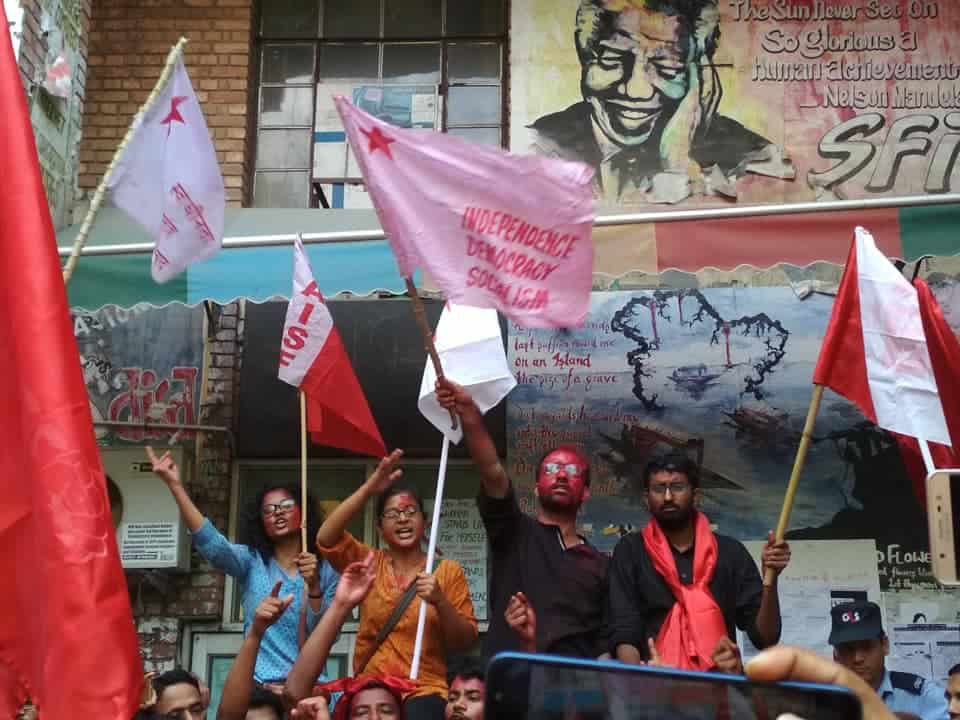
The JNU administration has upped their game. They have officially declared an Emergency-like situation through notices restricting protests, marches and demonstrations, shutting down dhabas and imposing curfew in hostels and stopping entry of “outsiders” to “curb violence” on campus.
Despite several reports revealing that ABVP members indulged in violence and provocation during and after the counting of the JNUSU elections, the JNU administration has responded by curbing democratic spaces and restricting the mobility of students. They are deploying age-old tactics of holding the university under hostage in the name of security.
Fortunately, the JNU students’ community is responding to the attack by continuing with the peaceful protests and marches.
My concerns are about what is to come. One cannot help but think that if the student wing of the ruling dispensation can go to such an extent in a Left-dominated university, what lengths will it go to if the Modi government loses in the 2019 general elections. We must take some cues to not only understand the attack, but to also know how to preempt such a move and resist it.
The JNU elections
There was something exceptional about this year’s election. It was conducted under adverse circumstances. In the last few years, it is no surprise that the JNU administration’s relationship with the student community has worsened. The administration has not only failed to act as a stakeholder of the university, but has actively colluded with the state in breaking the entire university.
The moment ABVP sensed defeat, it left no stones unturned to stall the process of counting. It is the collective will of the JNU community that ensured the continuance of the polling process of, while also resisting the violent attacks on them.
On the day of polling
Since polling day (September 14), the JNU student community has been on its toes to ensure the security of its mandate. After the presidential debate, the campus atmosphere was charged. JNU was celebrating its annual elections called the ‘carnival of democracy’. However, tension, anxiety and fear took over when students saw ABVP members barging into the polling booth at 3 am to assault election committee members.
After indulging in violent acts, ABVP stationed themselves in the polling booth. indefinitely. They argued that they had to take this extreme step to protest the starting of the counting process in the absence of their member. In JNU, the counting process for each post of all schools is done in the presence of representatives of the contesting candidates and parties, where they tally the votes with the EC members. This ensures that the process remains fair and free of prejudices.
Since there was no ABVP member in the polling booth, they resisted. The EC, in its defense, had repeatedly asked the parties to send polling agents. After Left parties and ABVP both failed to send their polling agents, they decided to start the counting. While the Left parties adhered to the rules, ABVP made an issue out of it and the stalemate lasted 12 hours.
The resolute spirit of the students ensured the survival of JNU’s democratic process and culture. The students apprehended that this was an ABVP ploy to stall the counting because they were losing in their bastions such as School of Sciences and the School of Languages.
Their apprehensions turned out to be true as the night gave way to day. While the appalled and aghast EC members asked ABVP members to apologise, the latter stood their ground objecting to the start of the process without their polling agents. Then, a meeting with the Grievance Redressal Committee was conducted. Students were sceptical of the role of GRC because it is an administrative body. It was unfortunate because the university student community takes pride in the fact that the entire election process is managed peacefully by the students despite razor sharp political differences. Thus, intervention from the administration was disappointing, especially at a time when there is a complete breakdown trust and communication in the campus, as students had to approach the court to revoke fines and charges imposed upon them by the administration.
On one hand, the untrustworthy administration was adjudicating over a matter that concerned students. On the other, ABVP repeatedly got into scuffles with majority of the students, both party and non-party.
With each passing hour, the situation got grimmer. There was news of Central Reserve Police Force (CRPF) waiting outside the JNU gates and students from Left parties being attacked by unidentified men.
Faced with adversity, the JNU student community congregated in large numbers in the polling area to ensure the process of counting was no scuttled. The deadlock resolved after 12 hours but the fear of threat and attack from outsiders loomed large as reports poured in of cars and busses entering the campus. Students decided to stay on until all the votes were counted. It paid off – the EC was able to declare the results the next day.
What saved the day?
The complicity between the JNU administration, ABVP and the ruling party is now an open secret. The vice-chancellor M Jagadesh Kumar suffers from the same aliment of selective concern/outrage as Prime Minister Narendra Modi.
Till date, not once has the VC tweeted about the attack on JNU students. Yet, he never shies from congratulating the BJP government for its electoral victories. While more than half of JNU students have been slapped with some fine or the other, we do not know of any ABVP member who has faced any such punishment.
Gauging the scale of the attack, all the Left parties have been in an alliance for the last two years. It’s the vibrant political culture of JNU that has been crucial in saving the institution from a majoritarian onslaught. The huge turnout during the election, right from presidential speech day to the polling day, is because of JNU’s participatory democratic culture. It was only due to this kind of political training that students not only cast their votes but also congregated in front of the polling booth for two nights to safeguard their mandate in the face of a violent threat from the party that they rejected both electorally and politically.
The violence and the ruckus that the ABVP created after they lost foretells what might happen if the BJP loses 2019 elections. The resistance shown the by JNU community also suggests that if progressive and the non-BJP forces have to save democracy, in addition to coming together on a platform, they have to make democracy as participatory as possible by extending solidarity to the issues and concerns of the people.
Ufaque Paiker is a research scholar at the Centre for Historical Studies at JNU.