
I don’t wear underwear. Not ever.
I do not wear a bra to work. I don’t wear one beneath my almost transparent cream and red polka dot blouse, the one with the Peter Pan collar. I don’t wear a bra even when it’s cold, and the outline of my nipple shows through my tee shirt. I do wear a sports bra when I run (which, if I’m really enthused, might happen once a week) though that’s just for comfort.
I have just turned forty-one. Mum took me bra shopping for the first time when I was thirteen. God knows I had little need of one. Back then I was barely five foot, three inches tall, I weighed less than fifty kilograms and was – like my mother – almost entirely flat-chested.
But Dad was insistent. I had buds more than breasts. Still, it made him uncomfortable that the evidence of my growing womanhood was on display for others to see. Quite frankly, once Mum let me know where Dad’s thoughts were tracking, I also became pretty uncomfortable about my tiny breasts attracting another’s view.
So, we went to a department store where a kind older lady ran a tape measure around my chest and then fitted me with a sports bra style in soft cotton. Clearly I had no need for an underwire. I was embarrassed. Mum wanted to celebrate the purchase in a way that my body consciousness wouldn’t allow. We might have had cake. She definitely had a cappuccino. Once we got home, I scurried down the hallway to my bathroom with my new bras, yanking them out of the plastic store bag to stuff them at the bottom of my underwear drawer.
I love my Dad. I loved him then, too. As a Kashmiri man, he was very dedicated to providing symbolic and physical scaffolding to hold his family in place. The symbolic scaffolding was Hinduism: the Kashmiri Pandit in him meant that the rites and rules and ritual around puja were very important to communicate. I grew up knowing how to greet my guru; believing that it was important to fast before morning puja; to not wear leather or suede near the puja mandir; to not wear shoes while taking tika; that a woman was not to enter a temple if she was menstruating; how to conduct a Shani-Daan, when and why. I could go on. All of these beliefs that I carry inside me like a mother carries love for a child.
The sense of belonging gifted to me through transmission of Dad’s beliefs was enormous.
As was the sense of safety provided by the physical scaffolding of home and hearth.
It was only once Dad’s gaze became turned to the taming of my growing woman’s body that the seamless alignment of our until-this-point parallel faiths came unstuck.
Instilled religious belief is peculiar in that permeates everything. I don’t think I realised how deeply Dad’s ideas of Hinduism had rooted in me until the corset of the faith I grew up with began to feel a little too tight. As I interpreted it, a good Hindu girl was faithful to the rites and respectful of the rules – an adherence outwardly expressed in the guise of physical decorum.
Intellectually, I could be as progressive and forthright as I liked. Our family loved a good argument, and smart expression of new and radical ideas was well received as fertile ground for enthusiastic dinner table debate. But I was expected to outwardly display myself as a model of virtue. Beautiful. Of course, always. But virtuous. Bra on. Modest.
As it turns out, as a self-determined woman, I’m not hugely into modesty.
I don’t love covering up. Not because I want others to look. But because I want to feel connected to the environment I’m moving through, I don’t want to feel physically strapped in and wrapped up. I want to feel the air and the sun and the fog and the cold. And yet the shame I felt around that initial discovery of myself as a woman drawn to physical openness was enormous. All of that patriarchal patter running around my brain.
“If men look at you with hunger, it’s your fault. You should cover up. It’s not about how you feel. It’s about how others will react. If you expose your body in any way it becomes an object. You cannot be you, for you.”
I don’t believe any of that anymore. But, God, it took a long time. And a lot of reprogramming.
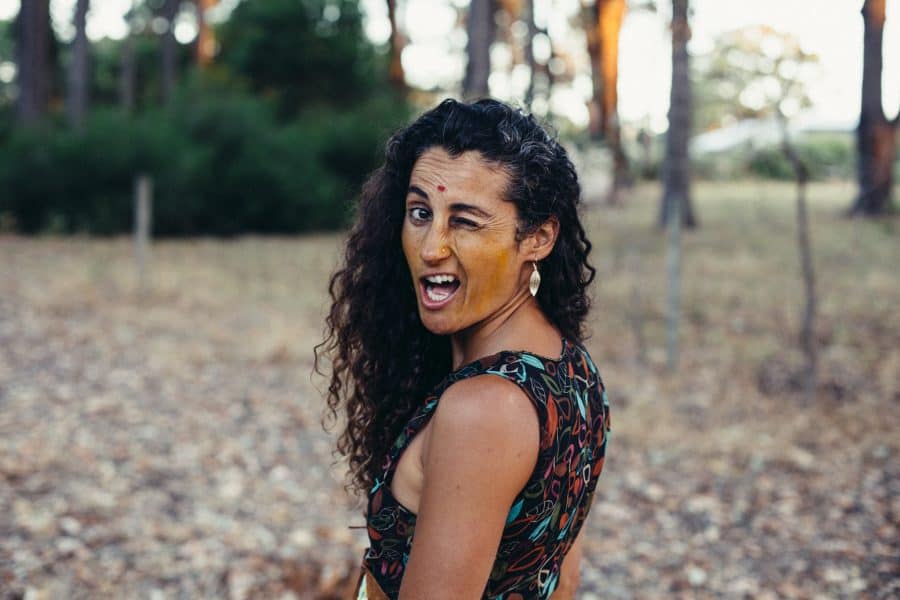
As soon as I unhooked my bra, permanently, I was forced to re-find ways to connect with the gods that I had been introduced to as a modest little Hindu girl. I needed my gods to be flexible, because I knew that finding my way back to faith as a woman who openly loves sex, who relishes the freedom of her body, and who finds beauty – and not shame – in nudity, would similarly equate with a looser religious practice, one less focussed on rules and undertaken in praise of fluid connection.
The steps toward change were small but significant.
When my kids came in the morning to get tika before school, I didn’t refuse them the right to sit in the puja mandir with their school shoes tied. It’s more important to me that they take my love than inciting the wrath of … who? … by keeping their shoes on.
Personally, I began to sit in my home temple and sing out my mantras naked. I still do, sometimes. I don’t think God cares. Seems to me He’s got a whole lot of other, more significant problems to worry about.
As a woman brought up within a strident story of belief and tradition, the act of embracing ideas of physical impropriety (nude swimming, bra-lessness, an unapologetic openness around the clothes I choose – and choose not to – wear), while maintaining my own softer, more forgiving version of Hinduism has unlocked something very significant in me.
Being daring physically has forced me to be more daring in my faith. To challenge the ideas I was brought up believing.
This highly personal and very constant engagement keeps my faith vibrant and active. I question. I think. I try new ideas. Of course, I still hold to many of the strictures within which I was raised. I very rarely eat before morning puja, for example, because I believe that it is beneficial to take a physically empty body into my prayer practice. Just as fasting during Durga Puja is a tenant I maintain.
I appreciate that there is risk in my attitude; some in my family are less than happy with my approach, and that has been cause for conflict. There was also a fear within me that questioning too much of what I knew might have left me with no faith at all.
In the end, my desire to live a life led by curiosity and not fear outweighed any reservations. And what repercussions I have faced have not yet outweighed the learning and the lightness. I’ve not a single regret for the path I’ve beaten. My life is filled with forgiveness and kindness and love.
Sarina Kamini’s memoir, Spirits In A Spice Jar, is out now with Westland Books. Follow her on Instagram and Facebook @sarina_kamini.